.............

.............

Monday, November 7, 2016

A Place to Return To

In the year 2000, as a fan who was introduced to the Final Fantasy series with the relatively unique diesel-punk setting of Final Fantasy VII, I hated this game and its generic fantasy world and characters. In 2016, with a fresh set of eyes and a different set of expectations, I find that I loved the game my second time through. The game I speak of would be Final Fantasy IX, the last of the series to appear on the original PlayStation console.


Back in the day (and to this day) I was a huge fan of FFVII and FFVIII's modern aesthetics. I absolutely loved the dystopian, conglomerate-driven, sci-fi fantasy fusion that VII was, and VIII's much cleaner, slightly futuristic setting was equally appealing. Then IX came along. The setting reverted to knights, bandits, and Victorian-esque nobility. The first thing we see is what is essentially a Shakespearean play. The character design is weird. Zidane is some sort of monkey man, and many of the NPCs are heavily caricatured, super goofy looking versions of animals. Even the humans look off. Eleven year old me's first response was indifference at best, distaste at worst. I thought the story was... ok, at best, but I never got past the drastically awkward shift in design.

The big headed, oddly designed characters came as a pretty big shock, even after the lego-like models of VII. The art style, setting, and tone of the story were much different than I expected.

Fast forward to today. After spending a good amount of time with this game again, I've really come to appreciate its unique setting. The fun loving rogue with a heart of gold that is Zidane is a nice change of pace from VII's serious Cloud, or VIII's brooding Squall. The setting is full of charm and oozes atmosphere. The scene in the very beginning when you barge on stage, interrupting the performance, and Garnet proceeds to go with the flow and improvises - extremely well, at that - made me instantly fall in love with the characters. The chemistry between all of them is very well done. 


What a charmer. I mean that sincerely. Zidane's wise guy personality was one of the highlights of the game's story, and his relationship with the sheltered princess Garnet - while cliché - was one of the most purely entertaining romance stories told in a Final Fantasy game.

The world design is excellent - the decision to go back to traditional high fantasy let Square show off some truly pretty, fantastical environments that are arguably the best among the FF trilogy on PSX. The ice cave, in particular, stands out as a personal favorite. Even walking through the streets of Alexandria as Vivi is impressive, even though you are only able to see a small portion of the environment. When you compare this to a similar section in VII, where you explore a small segment of upper Junon, the level of detail present and the quality of the rendered backgrounds is an immense leap from the previous two entries. 

The streets of Upper Junon looked nice, especially for the time, but they can't compare to...

The streets of Alexandria. Square's rendering technique had vastly improved by the time this game was made.
NeoGAF member Mama Robotnik has compiled several high resolution assets that were used while creating the world of Final Fantasy IX here, which I highly suggest that you take a gander at, as they show how beautiful the world that Square created truly is.


The slightly deformed designs have a purpose, too, contributing heavily to the game's unique charm. They're almost reminiscent of what you'd see in a cartoonier game, such as Secret of Mana or Chrono Trigger - heavily stylized, yet appealing in their own distinct manner. The ability system is fun to fool around with, and it's nice having four party members again after VII and VIII restricted you to three. Party members return to being unique in this entry, as well, as opposed to the relatively blank slates the cast of the past two games were. Much like the earlier Final Fantasies, each character has their own set of abilities, strengths, and weaknesses, which is something that the game absolutely capitalizes on. For example, the character Steiner is essentially a stylized version of the Knight class from the original Final Fantasy, where Vivi is likewise a newer rendition of the Black Mage; the game allows the two to work in tandem to utilize elemental sword attacks, such as by wreathing Steiner's sword in flame. I found the characters' uniqueness to be one of the highlights of the game from a mechanical perspective, and something that breathed additional life into the game's cast. 


ATEs, essentially little vignettes that show what the game's side characters are up to at any given moment, are a great addition to the series, and let you have a more complete view of the world and what the relevant people in it are doing. The game also boasts what might be one of Nobuo Uematsu's best compositions to date.

However, there is some stuff that I still have complaints about:

-Slow, slow battle system. And I mean slow. The game will take every opportunity it has to bombard you with fancy camera angles and long animations. The PC version has an added (and much needed) fast forward option, but the PS1 and PSN releases are stuck with a system slower than molasses.

-Trance is kind of a lame mechanic. Limit Breaks were far more streamlined/effective.

-Sometimes the character designs can get a little too weird. Kuja and Brahne come to mind...

Seriously, what the hell is this?
-The final boss is still as left field as ever, has no relation to the story, and is one of the most anti-climactic "twists" I've ever seen in a game that doesn't outright harm the story.

-Speaking of story, Amarant could have used some more of it - amidst the other fleshed out and well written characters, he's just kind of "there" for most of the game. 

Sup. I'm cool and mysterious. I also have big hands. I'll just hang out with you guys for a while, if that's cool.
-This is more of a matter of taste, but I think that Blank should have been a permanently recruitable, hidden character. It still annoys me that VII was the last FF to have hidden characters.

Overall, I really enjoyed this game on my second go through, and I have much more appreciation for the story and visuals this time around. This is mostly because my expectations weren't colored by the comparative disappointment that I felt after loving VII and VIII's styles, and expecting more of the same here. Appreciating IX for what it is makes it much more enjoyable. Oh, and Beatrix is one of the best female characters I've seen in a game, and one of the coolest characters I've seen, period.


Sunday, November 6, 2016

Palette Problems

The Briefs family is the victim of a colorful identity crisis.


I'm talking about the characters from Dragon Ball, of course.

In an attempt to unravel the relatively complicated story behind the hue of their hair, let's look at the problem backwards. The most recent Briefs character to appear in the series is Future Trunks in Dragon Ball Super. Super Trunks (not to be confused with Super Saiyan Trunks) is the same character from the original run of the Dragon Ball Z anime and the Dragon Ball manga, now in his 30's. Aside from looking a lot thinner than his previous appearances, as all characters in Super do, there's one glaring difference that has been throwing people for a loop.


His hair is blue, as opposed to lavender. I mean, it looks cool enough, but why change such an iconic piece of his character? His bright purple hair was his most prominent physical trait. And to make things even more confusing, his kid self - the Trunks from the present timeline - still has his original hair color, with the characters even standing right next to each other at times!


Toei, the animation company behind Dragon Ball Super, even went the extra mile to tell us that this was a deliberate change in the story. Bulma identifies Trunks by his blue hair, and the flashbacks we see of Trunks from Z are either in black and white, or recolored to match his newer head of hair.

The flashback originally seen in History of Trunks and Trunks: The Story was reanimated in Dragon Ball Super to show our future warrior with a blue, as opposed to purple, head of hair.
So what's the deal? Why the sudden and inconsistent change? Let's break it down piece by piece.

All lines lead back to Akira Toriyama himself, the man who designed the character in the first place. For the uninitiated, Toriyama was only directly involved with the manga run of the original Dragon Ball, and was only a supervisor in regards to the Dragon Ball Z anime and its related movies. There's one key difference between the manga and the anime: the manga is black and white. We may identify Trunks by his lavender hair, and Toriyama may have colored it that way himself at one point in the past, but for Toriyama, the hair color was less ingrained in his mind than one would be led to think. This is fairly common in the manga industry - JoJo's Bizarre Adventure is the most extreme example of characters being colored in all sorts of different ways, a trend that was even carried over into its modern anime adaptation. This was the original drawing of Trunks Toriyama handed over to Toei for Battle of Gods, which Toei later corrected to his trademark purple for the movies and in Super.

However, when Toriyama came to Toei with the design for Future Trunks' appearance in Dragon Ball Super, his hair was once again blue.


This time, Toei went with Toriyama's rendition of the character, without changing his appearance. However, they had already decided to run with purple for the other version of Trunks, leading to a conflicting sense of continuity between the characters. It could be that Toei did not want to argue with Toriyama's input, or simply did not care about the discrepancy between the two characters - a different hair color would be easier to classify as a new character and to sell toys with, after all, so the decision may have had a business-oriented element to it as well.

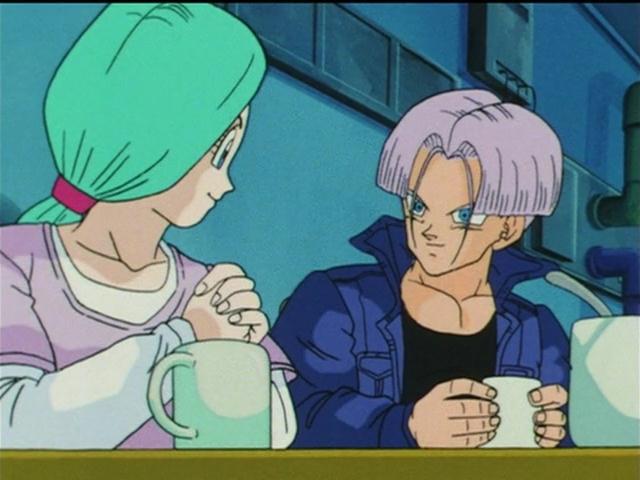
That's not all - there's another layer to the character's change in design. Trunks' hair has always been colored to match his mother, Bulma. But wait, didn't they have different colored hair in Dragon Ball Z...?

I love this picture. I'm not sure why. Maybe it's because Trunks' facial expression is the very definition of "screaming Internally."

This is where the rabbit hole extends even further. In the original run of the manga, Bulma's hair was most frequently shown as purple - it was colored green for her first appearance, which was likely the reason behind its coloration in the anime, but for most of her manga-related appearances, her official hair color was purple.


It was even changed back its purple color for the TV special, Path to Power.


However, her hair color had already been established as green in the mainline show, so it remained as such in all of her future appearances. However, her father and her son retained their "correct" manga coloration of purple. This persisted until over a decade later, when the series was rebooted with Battle of Gods, where it changed to a different color altogether. Blue.

The light blue hue seen here was made a bit darker in Dragon Ball Super, showing a gradual change from her Z colors to her Super colors. A much less drastic change than with Trunks.
Perhaps it was because the change was less noticeable than it was with Trunks, as blue and green are closer together on the color wheel, but Toei stuck with Bulma's blue haired design, while still reverting Kid Trunks back to his usual purple color. However, when Future Trunks appeared, it was clear that his hair had been designed to match his mother's, and Toei decided to go with it, leaving us with two inconsistent versions of Trunks.

There you have it. The blue hair dilemma is a multi-layered issue with roots in how manga is adapted to anime, and a lack of consistent communication between the animation team and the manga author. It wouldn't bother me as much as it does if they had decided to make both Trunks have blue hair, but as it is, it's a bit jarring. However, the change got at least one thing right; mother and son finally have the matching color hair that they were originally intended to have.


Sunday, October 30, 2016

The Glory Days of Valve

At this time every year, I replay The Orange Box. And it still holds up. The Orange Box was an amazing collection of games, both new and old, and it came with some of the most groundbreaking games that the industry has seen to this day. Celebrating its ninth anniversary a couple of months ago, this compilation of sorts left me so dramatically floored that I feel the need to attempt to recapture the initial excitement of its release every year.

Before we get into the real meat of things, let's back up a bit: What was in The Orange Box? Five games released for the price of one, it included two games that were the previously released fan favorite Half-Life 2 and its expansion Half-Life 2: Episode 1. But the real heart of the collection were its three new games. Yep, that's right — two games that were, at the time, still relatively new, and three that were brand new, all for the price of one game. That's how you hook the fans, folks. "The best deal in video game history," indeed. (Remember, Steam sales didn't exist yet).

So let's take a little trip down memory lane.

It's no wonder Valve would later be known for Steam Sales. This was only the beginning. At the time, a deal like this was unprecedented.

Flashback to 2007. I had just graduated high school. I was sort of aimless, unsure of what I wanted to do in life, and was attending a local community college while trying to figure out my future. I had vague notions of majoring in psychology. Ha. HA! Oh, you young fool. Anyway, that's not what this article is about. That fall, a miraculous collection of games was released on PC under the inconspicuous title of The Orange Box.

Half-Life 2: Episode Two


This was the big game that everyone was waiting for. The direct continuation of the previous expansion, Episode One, Episode Two advanced the Half-life 2 story and featured some very impressive technical enhancements along with the new campaign. Most of the game took place outdoors, which was a very big change of pace from the cramped dystopian cityscapes of the first two outings, and the environments were absolutely gorgeous.

Episode 2 featured new enemies and outdoor environments, making it feel fresh coming off of the reiterative cityscapes and tunnels of the last two entries.

The campaign itself was fast-paced and gripping, and held the player's attention from beginning to end. Episode Two featured a new Hunter enemy, which had only been seen briefly in a recorded message in Episode One. The Hunter was a dangerous and intimidating enemy which could follow you, indoors and out. Here, the story set in motion over the previous two games was in full force, and it ended on a massive cliffhanger that deeply affected fans everywhere. We're still waiting on the resolution to that cliffhanger, but I digress. The game met, and even surpassed, fan expectations, becoming a critically acclaimed success.

Team Fortress 2


The second new game in the box was Team Fortress 2, a cartoony, team-based shooter. TF2 had a rocky development cycle, even starting out as a traditional realistic army shooter, but the final release was unlike anything anyone had seen at the time. Each map was brimming with style, and the Source engine certainly did the game a few favors in both looking nice and running very smoothly. You did not simply choose your class in TF2; each class was a distinctive character with its own voice quips, looks and personality.

What other team based shooter at the time had a class dedicated entirely to healing? With a gun? Go ahead, I'm waiting for an answer. TF2 felt entirely unique at the time of its release.

Classes, such as the Medic or Pyro, were highly specialized and offered new forms of gameplay. Sure, we'd all seen flamethrowers in an FPS before, but to design an entire class around the concept was something innovative, not to say anything of the concept of a strict healing/support class. The highly stylized art, characters that brimmed with personality, innovative map design and streamlined, fast-paced gameplay all came together to create a massively addicting experience. The game was, in many ways, the precursor to Blizzard's highly successful Overwatch.

Portal


The real shocker, for many Orange Box aficionados, was Portal. This is the game that I think everyone expected to be nothing more than the bonus game of The Orange Box; a short and sweet fan-made romp that would be enjoyable, but ultimately forgettable compared to the big names it shared a box with. Boy, did it surpass everyone's expectations.

The clean and sterile art style allowed the game to work together with its deceptively innocent concept to tell a gripping story with a very dark undertone. The plot was one that was accentuated greatly by nonverbal storytelling techniques, such as writing found on the walls of Aperture Science labs, and GLaDOS proved to be a villain as memorable as the bone-schilling SHODAN from the acclaimed System Shock 2.

While the real star of Portal was its colorful antagonist, the puzzle based gameplay was fairly revolutionary at the time, as well. Portal took full advantage of its 3D rooms and portal gun to offer an engaging experience unlike any other game that was out there.

GLaDOS was an effective villain due to how she was both eerie and completely in control, but she also served as comic relief, a blend of supposedly opposing character attributes that was near flawlessly executed. Who doesn't remember the ominously innocent voices of the actually very deadly turrets scattered throughout the labs? "The cake is a lie" persisted for years after the game's release, and the Companion Cube's loss was comically lamented by fans everywhere.

Portal wasn't just about the story, however. The game itself also proved to be wonderfully new and experimental, and offered a puzzle-based experience like no other game had done before. It was so successful, it led to a full-fledged sequel years later.

While you can't step in the same river twice, all of the games included in The Orange Box collection hold up extremely well and remain very enjoyable, even nine years after their release. Hats off to one of the biggest and best releases in gaming.

Saturday, October 29, 2016

Back to the Beginning - Samus Aran's "Zero Mission"

Short post today. I've been updating this blog less and less, as I am wondering if it is worth continuing to do so. As such, I've been on an unofficial hiatus for quite some time. The future of this blog is up in the air - I'd love to continue with it, but time will tell if that is feasible or not.

I'm a huge fan of Metroid Prime, Metroid Fusion, and Super Metroid, and I rather enjoyed the second two Prime games as well, even if they fell a bit short of the greatness of those three. I'd never touched the original Metroid or its sequel, so I decided to fire up the Wii U VC and give the first game's remake, Zero Mission, a fair shot. I can safely say it ended up being just as good as what I consider to be the Metroid Trinity.


First: it has all the snappiness of Fusion with all of the exploration of Super. Super was always a very lumbering, very floaty game, while Fusion's animations and inputs were quick and concise. Zero Mission goes for the Fusion approach, which is much appreciated. Fusion was a wonderful game - I even liked its narrative focus - but it was a bit too linear for my tastes, so it was nice to see the franchise return (in more ways than one) to the open ended nature that it's known for. Zero Mission was a perfect Fusion (ha ha) of the two.

Second: it's beautiful! There's dazzling plasma animations for Samus' cannon and every area looks unique, is full of color, and pops out at you. What I love about this is how well it ties into Super, whether it was intentional or not - this is Zebes under Mother Brain's control, alive and full of energy. The return to Zebes has it almost in ruins, and it's much darker and more dismal. The upbeat soundtrack was also a plus for me. Did I miss the "grittiness" of Super Metroid? Yes, I did, but the game's brightness ended up being a positive for me regardless. It's not like Zebes was suddenly a happy place because it was bright, either; it still felt very alien and hostile.


Third: The Zero Suit segment at the end was exhilarating. It took the adrenaline from the SA-X segments in Fusion and upped it tenfold. Crawling through tiny spaces with Space Pirates right on your tail as you stop to shoot the blocks blocking your way had my blood pumping like no other Metroid game has managed to do. It went from stealth to INTENSE action at the drop of a hat. Getting the Power Suit at the end was a nice touch, and Mecha Ridley was appropriately creepy and menacing (if not a bit too easy).


I very much enjoyed my time with this game. It was a bit short, as was to be expected, but it was overall a great experience. I loved seeing where the Brinstar theme in Smash Bros. came from! I haven't spent much time with Another Metroid 2 Remake, yet, but it seems like a worthy successor to Zero Mission. It's a shame Nintendo pulled it down, but at the same time, it's good that it managed to get released.


Monday, September 19, 2016

Of Canon and Continuity

It seems to be more common to "reboot" a franchise or series than it does to tell a serialized story. Even when a story directly continues in a sequel, it often stands largely on its own and does not call very much attention to the games that came before it outside of recurring characters or off-hand references. Uncharted comes to mind - you're always Nathan Drake and his merry band of thieves and adventurers, but each story is mostly self contained.

There are, however, the occasional standout franchises or long running series. Among all games that treat their canon with respect and expand upon it well, Metal Gear Solid as a franchise, but especially the second game, is the king for me because of its added meta-narrative. What follows is a spoiler-free synopsis of why I think this is the case.


MGS2 goes about deconstructing the idea of a perfect sequel. You begin as Snake in the Tanker, and it has all the makings of a by-the-books sequel to the previous game - an older, more grizzled Snake, a bigger and badder Metal Gear, some returning names and villains from the first game... until it drops you off a couple of hours later as a new character. He is Snake in every way, but he also isn't. His code name is Snake, but it's quickly revoked. He's an enhanced supersoldier like the Snake we know, but unlike Solid, he's a newbie. He's obedient and capable, but he doesn't have the cool and composed air that Solid Snake did, instead frequently revealing his nature as a rookie on the field and losing his cool or making outbursts towards others. He's fighting an organization similar to FOXHOUND, but unlike FOXHOUND's clear-cut demands of a large sum of money and the corpse of a genetic supersoldier, their true motives and capabilities seem cloudy by comparison.

The villains and the skeletal structure of the narrative are deliberate retreads of the first game, in a much more hamfisted way than the tanker portion of the game. This framework all comes to a head during the endgame, when the player and their own expectations are used to shatter their perception of what the game has apparently been trying to do until that point. Not only that, it then shatters those expectations with twist upon twist upon twist. What is the S3 plan? Even after finishing the game, you might still doubt the validity of what you've been told.


Even beyond the meta-narrative, and the fact that it so brilliantly uses its own medium to drive home a point, there is a legitimate extension of the world introduced to us so far. We learn of other organizations similar to FOXHOUND, the impact of Metal Gear on the world at large is addressed, Solid Snake gets a proper continuation of his story and grows quite a bit as a character, and other characters, such as Otacon or the colonel, return or get properly alluded to. This all happens while introducing us to new characters and new stories, even when those characters may initially feel like retreads of the previous game. It really is - despite its deconstruction of the concept - the perfect sequel in my eyes.


Metal Gear Solid 3 carries on the notion of building a cohesive world even more by going back in time to reconcile the narratives of the Solid games with those of the original two Metal Gears by introducing us to Solid Snake's "father," Big Boss. Up until this point, it was a bit of a hard sell that the noble Snake (and even the not so noble Snakes) were clones of this man, but by going back in time and seeing the physical and ideological resemblance, it helps the player accept Big Boss's relationship to his sons, and his fall from grace, in a very organic way.

You can see which pieces of the father were inherited by which son, and Big Boss himself, known during this time as Naked Snake, feels like a fresh new character despite being a literal and figurative clone of those who came before. This Snake grew up in a more natural environment, and, at the time the game takes place, is not a genetically enhanced or otherwise special soldier. He is simply a man on a mission, and his character reflects that. He jokes around with his support team, he smiles, and he expresses self-doubt, all while remaining a rock solid agent that's willing to get the job done. Metal Gear Solid 3 uses its protagonist to create a perfect fusion of the old and the new.


I think the entire Solid series, outside of the subsequent Big Boss games (Peace Walker and The Phantom Pain), is one of the best examples of building a strong continuity between games that there is. Even from a gameplay standpoint, you watch the games slowly evolve; everything is familiar enough to be the Metal Gear you love, but different enough to be a fresh experience. MGS1 has the stealth based gameplay and the soliton radar. MGS2 keeps these, but adds dynamism to its encounters by having bodies stay on the ground and soldiers call for backup. MGS3 take the idea of focused infiltration and sticks it in a wide open jungle setting, while also removing "future tech" such as the soliton radar and replacing it with 1960's technology. MGS4 has quality of life improvements such as crouch walk and a new camera. Everything about these games feels distinctly "Metal Gear," even when it's a new idea, and that is why I think this series truly serves a shining example of maintaining an excellent continuity between entries.

Thursday, July 14, 2016

Turn Based Brilliance: An Appreciation for Fire Emblem


Fire Emblem has entered into the public spotlight with its recent surge in popularity with Awakening, Fates, and the large cast of Fire Emblem characters in Smash Bros. I'm appalled that we almost never got to see this series in the west. If it weren't for Marth and Roy in Smash Bros. Melee, I doubt we ever would have. Thankfully, Nintendo went against the decision to remove them from the American version of the game. Yes, that almost happened!

Fire Emblem Theme

I recently replayed through Fire Emblem (7: Rekka no Ken/Blazing Sword) on the Wii U Virtual Console, and it holds up extremely well. Awakening was one of the best games to come in 2013 amidst a slew of other amazing "Year of the 3DS" games, and is probably still one of the best games on the system.

The older entries in the series, the ones that were never translated, are challenging, but very fun games: FE4 with its trademark generational system is great, and FE5, one of the hardest games I've ever played, both stand out as some of the best strategy RPGs in the genre due to their unique mechanics and crushing but rewarding difficulty, respectively. Fire Emblem 4 and 5 also take a seldom seen approach in that Fire Emblem 5 is a midquel to Fire Emblem 4, taking place in between chapters five and six of that game. The story is full of political intrigue - it's certainly the most politically oriented set of games in the series - and takes place over the span of two generations, so you're able to watch the children of the heroes take over at a certain point. It's an ambitious concept that the games pulled off very nicely.

The Japanese box art for Fire Emblem 4. Its subtitle is "Seisen no Keifu," or Genealogy of the Holy War. Pictured are Sigurd, the hero of the first generation, and Celice, his son who takes over in the second half of the game. Sigurd, who can be seen here riding his trademark white horse, has the distinction of being one of the only lords in the series to be an adult, rather than a teenager.
My first experience with Fire Emblem was, like most Americans, with Marth and Roy. Reading their trophy entries in Melee revealed that they came from Japan only titles, which added a certain sense of mystique to their character, making them feel somewhat exotic when compared to the cast of otherwise familiar characters. When Fire Emblem was announced for the west, I played the series for the first time, and fell in love instantly. I love how every unit has a name, a class, and a face. (I hate how reclassing took away the individuality that came with chaining certain characters to certain classes, but that's another story). Not one unit is a generic nobody, and every single one has a personality and a history.

The story is almost always cliche, but I don't think there's been one FE with a plot I did not enjoy. Most of the stories revolve around a sacred item known as the Fire Emblem, whose history, purpose and appearance changes from game to game, and a bid to save your kingdom from an evil invader. As I mentioned above, some of the games do step outside of the series' comfort zone of "little lordling saves the world and rescues his kingdom," such as the Tellius duology - Fire Emblem: Path of Radiance and Fire Emblem: Radiant Dawn - where the main character, Ike, is not a lord, but rather a mercenary leader. Even in this case, the game is still very much grounded in high fantasy tropes, but again, this isn't necessarily a bad thing. Without spoiling too much, the Tellius games even manage to make ye olde Black Knight trope interesting again.

Hero Ike faces off against The Black Knight. The knight's identity is unknown for most of the two games that he stars in, and he has a rather personal connection to Ike and his father that is also shrouded in  mystery. His story, while certainly cliche in many ways, is one of the best told and most gripping story arcs in the series.
I am playing through Fire Emblem 6: Sword of Seals right now, and perhaps the most stand-out feature of this game is in how difficult it is compared to Blazing Sword. Roy also pales in comparison compared to most lords, being relatively weak and uninteresting even by cliche Fire Emblem standards, which is disappointing after being introduced to him through his much superior Smash Bros. incarnation. Playing it as a sequel to Blazing Sword is neat, however - it picks up very nicely from FE7's epilogue and "cliffhanger" ending. Seeing returning faces is great, too - I never realized that the map in Laus was shared between games, or that Eric was the map's boss in both of them. FE7 is clearly a more polished game, and rightfully so, as it came out afterward, but I'm really liking FE6's colorful character design and larger scope in regards to its plot. The extra challenge can be nice, too. Despite Roy's lackluster lordliness, it's nice to finally see him in his own game after years of him being "that guy from Smash Bros."


As long as I'm on the subject, I might as well parrot some love for my favorite class in the series. Mine has to be Swordmaster and its variants, although it pains me not pick other amazing classes like Hero or Paladin. From the Fire Emblem Wiki:
The Swordmaster (ソードマスター, Swordmaster; 剣聖 Kensei, Sword Saint, in the Japanese version) is the promotion of the Myrmidon. These lightly armored foot soldiers are capable and have an increased chance to deal critical attacks. The Swordmaster has a high amount of speed when compared to many of the other classes, giving them high accuracy and evasion, making them a very deadly class. The Swordmaster class was officially introduced in Fire Emblem: Genealogy of the Holy War (where Ayra and her daughter Larcei defined the class, including its signature skill, Astra). The Blade Lord Lyndis from Fire Emblem: Rekka no Ken and the Great Lord Eirika from Fire Emblem: The Sacred Stones are considered to be a variations of Swordmasters, having the same stat caps. The average HP stat of Swordmasters varies greatly regardless of gender, it can be high or low.
My introduction to this class, like many others, was with Fire Emblem: Blazing Sword, commonly known as Fire Emblem in the west. Lyndis is a lordly variant of the Myrmidon and Swordmaster classes, but the character that really sold me on them was Karel, the Sword Demon.


A pre-promoted unit in any given Fire Emblem has an 80% chance of being not as good as a unit that you raise yourself, but Karel tears up the battlefield with the best of them. He looks extremely cool and returns in the next chronological entry as an older, wiser, and redeemed man, now known as the Sword Saint.

An older Karel finds redemption. As his story is told in reverse, this is the first incarnation of the character you see, provided that you play the games in their order of release.
The animations for Myrmidons and Swordmasters are also among the best in the series, with a very flashy flair to the way that they move and an extremely intense critical hit. Even their regular attack has them spinning through the air. Lyn's Blade Lord variants are quite possibly the most stylish critical animations in her game. You can always count on the Myrmidon line to add an extra bit of cool to their attacks.

Karel's critical animation from Fire Emblem 7.

Lyn, the Blade Lord, with her own unique critical animation.
Lyn uses her divine weapon to up the ante. The Game Boy Advance sprites were, as you can see, extremely stylized, and are largely regarded to be the best style of presentation that the series has had.
Even when the series moved onto awkward 3D models in Path of Radiance and beyond, the Swordmaster class always managed to convey a sense of immense speed and skill with its animations, with its units sheathing and unsheathing their swords extremely quickly and making very precise strikes with their blades. 

The most recent Fire Emblem, Fates, has quite possibly the most brokenly overpowered character in any of the games in Ryoma, and his class is... you guessed it, Swordmaster! Ryoma takes the class to an entirely new level with his sacred sword, Raijinto, which essentially functions as a Silver Sword with a ranged attack. His terrifyingly strong offense combined with his high dodge makes him nigh unstoppable, and represents the best of what the class has to offer.


Overall, I'm very glad that the series is finding so much recent popularity. Hopefully it continues for years to come. Cheers to an amazing series!